What is a UGC creator? How the work, pricing and usage rights actually work
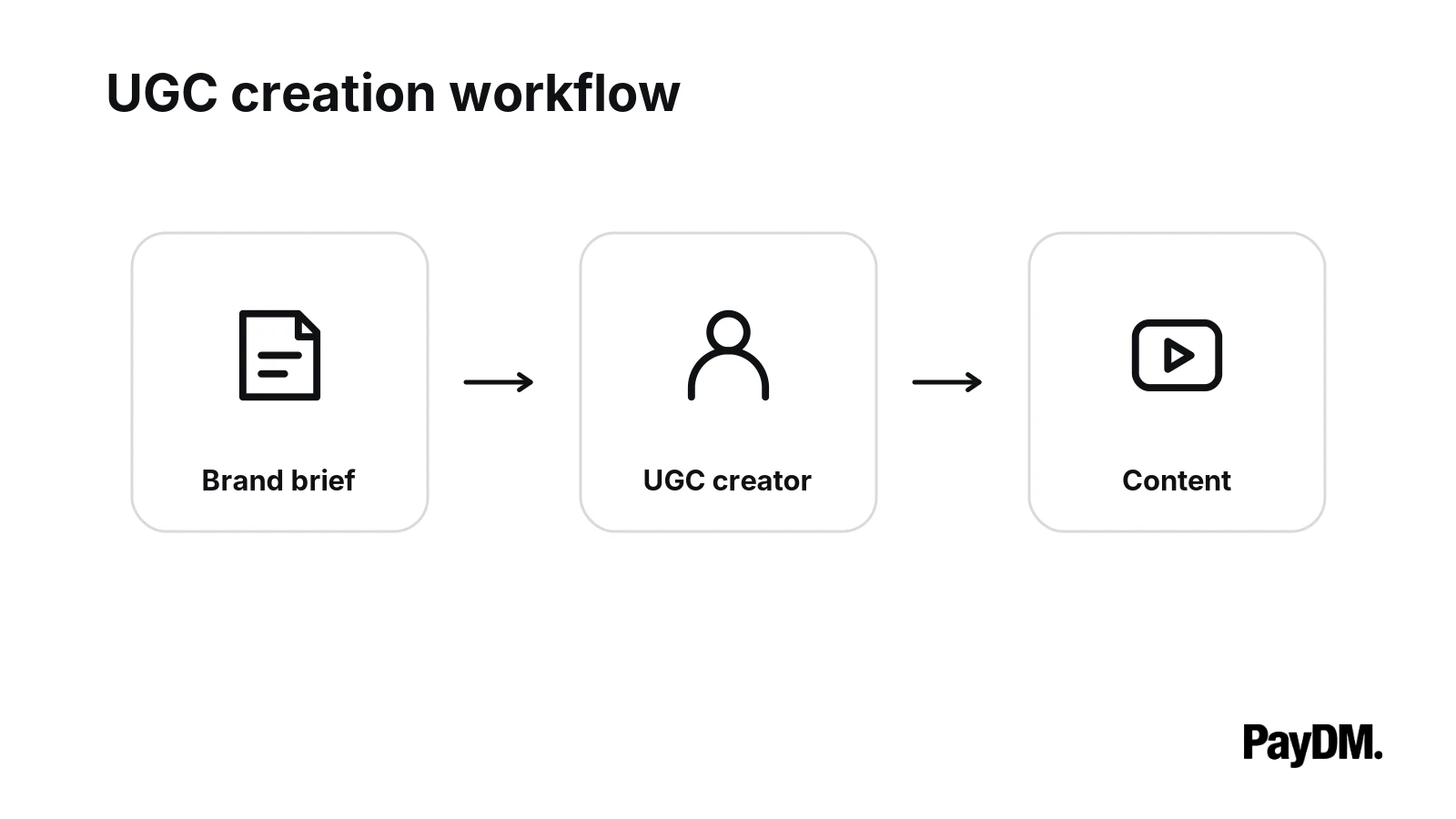
A UGC creator is paid by a brand to make content — short videos, photos, demos or testimonials — that the brand publishes on its own accounts or in its ads. The brand buys the content and the right to use it, not access to the creator's followers, which is why a UGC creator can work with a small audience. Price a UGC job from its parts: preparation, filming, editing, revisions, then usage rights quoted separately. A free quote worksheet is included below.
Short answer
- What it is
- Commissioned content a brand publishes itself. The creator may never post it on their own account.
- What the brand buys
- The deliverable plus a licence to use it: where, for how long, and whether in paid ads.
- Followers needed?
- No universal threshold. Brands judge the portfolio; individual marketplaces may set their own rules.
- How to price
- Labour (brief, filming, editing, revisions) plus expenses, with usage rights and exclusivity as separate lines.
- Biggest mistake
- A flat fee that silently includes unlimited revisions and perpetual paid-ads usage.
Free template: a UGC quote worksheet with labour lines that multiply out for you, separate lines for usage rights and exclusivity, and a total. It suggests no rates: you enter your own.
UGC creator vs influencer
In one sentence: a UGC creator sells content and a licence to use it; an influencer sells content plus distribution to an audience that trusts them, so the two are priced on different things.
| Question | Paid UGC job | Influencer sponsorship |
|---|---|---|
| What is sold? | A deliverable and usage rights | Content, an endorsement and reach to the creator's audience |
| Who posts it? | Usually the brand, often as an ad | Usually the creator |
| Does follower count matter? | Often little; the portfolio matters more | Usually part of the price |
| What is measured? | Quality, on-time delivery, ad performance if the brand shares it | Reach, audience fit, clicks, sales |
| Main contract risk | Usage scope and revisions | Deliverables, disclosure, exclusivity |
One person can do both, but quote them differently. If a brand asks you to post on your account and lets it run the video as an ad, that is a sponsorship plus a UGC licence, and the fee should cover both.
What a usable brief contains
"Three TikToks for our moisturiser" is not a brief. A 20-second demo from talking points is a different job from a scripted testimonial with three reshoots. Before quoting, get answers to these:
- Product and claims: what you may say, and who approves claims (health, finance and beauty claims need care).
- Deliverables: number of videos, length, orientation, captions, raw footage or not.
- Script: written by the brand, by you, or loose talking points.
- Revisions: how many rounds are included.
- Usage: organic posting, paid ads, which platforms, for how long, which countries.
- Deadline and payment terms.
Example scope, written out: "Two vertical product demos of 20–30 seconds, creator-filmed, claims supplied by the brand only, one revision round, organic use on the brand's accounts for three months, paid ads excluded." It is an example of how specific a scope can be, not a legal template; a real contract should also cover approvals, ownership and the law that applies.
How to price a UGC job without copying rate cards
Rate cards shared online rarely say what they include: length, revisions, licence, country. A quote you can defend starts from the work itself:
Quote = (brief + filming + editing + revisions) × your hourly cost + expenses + usage licence + exclusivity
Worked example with invented numbers: 1 hour of preparation, 3 of filming, 2 of editing and 1 for revisions is 7 hours. At an internal target of $35 an hour, labour comes to $245 before equipment, props, the usage licence, tax or margin. That figure is your cost floor, not a market price, and not an average UGC rate.
After each job, compare estimated and actual hours. Two or three projects of real data tell you more about your pricing than any public "average UGC rate" without a disclosed method.
Usage rights: the line that changes the price
The same 30-second video can be worth very different amounts depending on how the brand uses it. Keep each of these as a separate line in the quote, as the worksheet does:
| Request | Why it costs more | What to write down |
|---|---|---|
| Organic posting only | Baseline use | Channels and duration |
| Paid ads (whitelisting or the brand's ad account) | The video works for the brand at scale, often for months | Platforms, duration, countries |
| Exclusivity | You turn down competitors | Category, duration |
| Extra hooks or edits | More production time | Price per variant |
| Raw footage | The brand can re-edit your work | Whether included, and for what use |
| Perpetual use | No end date on the licence | Avoid by default; price it explicitly if accepted |
When a brand comes back after delivery asking for three new hooks and six months of paid ads, the job has changed. Put the change in writing as an amendment instead of absorbing it.
A portfolio without inventing clients
Make two or three sample videos with products you own and can talk about honestly, and label them as unpaid samples. Cover three useful types: a how-it-works demo, a video that answers a buyer's objection, and a comparison. For each, note who it is for, what problem it addresses, and what you wrote, filmed and edited.
Do not imply that a brand commissioned a sample, and do not quote performance numbers you do not have. A short portfolio page with the videos, your turnaround time and a contact address is enough; a one-page media kit can carry the rest.
Disclosure
When UGC runs on the brand's own channels, the brand is the advertiser and the usual advertising rules apply to it. When paid content appears on your account, or presents you as an independent customer, the commercial relationship has to be clear to viewers. In the US, the FTC's Disclosures 101 covers this, including free products; in the UK, the ASA and CMA influencers' guide; in France, the 2023 influencer law requires a "Publicité" or "Collaboration commerciale" label. A UGC video should not pretend to be a spontaneous customer review.
Finding the first clients
Shortlist brands that already run creator-style ads in a category you can demonstrate well. Watch their current ads and note one concrete angle they are not using. Your message can be two sentences: the angle, and a link to the most relevant sample. Track replies, not messages sent. The pitching method and a tracker are in how to get brand deals.
PayDM is not a UGC marketplace, but it does pay creators for one kind of video: through PayDM Creator Rewards, selected TikTok and Instagram creators earn €1 to €3 per 1,000 verified organic views on approved videos about PayDM, with a cap per video agreed before filming. It is performance pay, so it sits alongside fixed-fee UGC work rather than replacing it.
The paid inbox is a separate case. It only fits if your own audience keeps asking for your personal advice — for example, followers asking how to start as a UGC creator in their situation. That is a different job: one paid private question, one written reply within 8 days or an automatic refund. It is not a way to sell videos to brands.
Frequently asked questions
What does a UGC creator do?
They film and edit content — demos, testimonials, tutorials, unboxings — that a brand uses on its own accounts or in ads, under an agreed licence.
Do UGC creators need followers?
Not as a rule. The brand buys the content, not your reach. Some marketplaces or brands set their own criteria.
How much should I charge for a UGC video?
Start from your hours and your own hourly cost, add expenses, then price usage rights, paid-ads use and exclusivity separately. Public rate cards rarely say what they include.
Does the brand own everything I film?
Only what the contract grants. Write down the channels, duration, countries, paid-ads permission and whether raw footage is included.
Is UGC the same as influencer marketing?
No. UGC is production for the brand's use; influencer marketing also buys distribution to the creator's own audience.
Sources
- US Federal Trade Commission, Disclosures 101 for social media influencers, checked 27 October 2026.
- ASA and CMA, Influencers' guide to making clear that ads are ads, checked 27 October 2026.
Hours and hourly cost in the example are illustrative, not market rates.