How much does YouTube pay per view?
YouTube does not pay a fixed amount per view. A monetized channel earns a share of ad and Premium revenue — 55% of net ad revenue on long-form videos and 45% of its allocation from the Shorts Creator Pool — and YouTube reports the result as RPM, your revenue per 1,000 views. To estimate earnings, multiply eligible views by your own RPM: at a $3 RPM, 1 million views is $3,000; at $1, it is $1,000. Your RPM, not someone else's, is the only figure that applies to your channel.
Short answer
- Does YouTube pay per view?
- No. It shares ad and Premium revenue with channels in the YouTube Partner Program. Views only earn when they generate eligible revenue.
- The number to use
- RPM: what you earned per 1,000 views after YouTube's share, as shown in YouTube Analytics. Not CPM, which is what advertisers pay before the split.
- Revenue shares
- 55% of net ad revenue on long-form videos; 45% of the revenue allocated to you from the Shorts Creator Pool.
- 1 million views
- 1,000 × your RPM. There is no universal figure; the table below shows how fast it moves with RPM.
- Not included in RPM
- Sponsorships, affiliate commissions, your own products, services or paid advice. Track those as separate lines.
The formula you can check yourself
In one sentence: estimated YouTube revenue is views divided by 1,000, multiplied by an RPM — ideally your own, from YouTube Analytics — applied separately to long-form and Shorts.
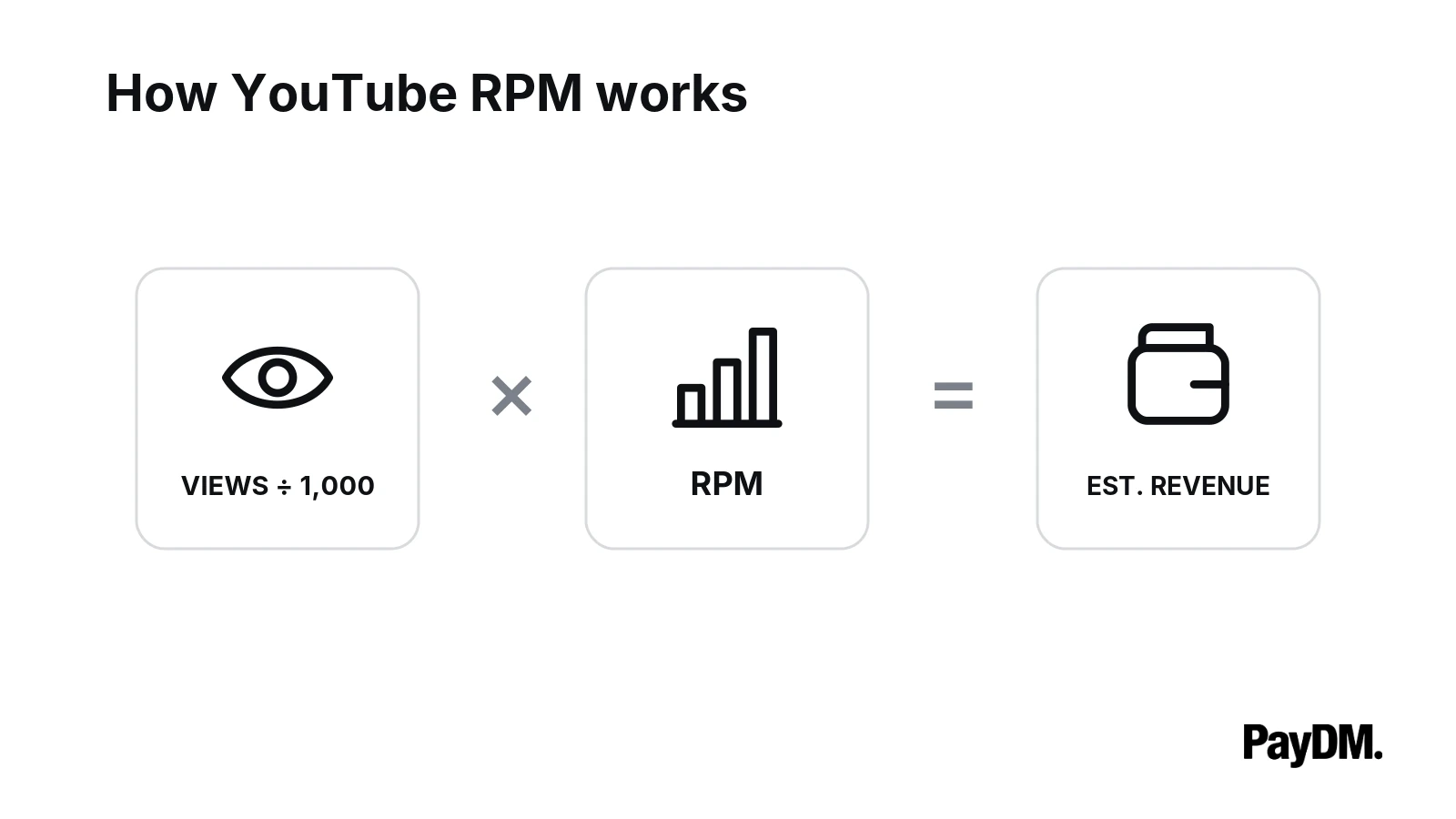
Estimated revenue = (views ÷ 1,000) × RPM
This is arithmetic, not a forecast. If your channel is already monetized, its historical RPM by format is a better input than any number found online. If it is not, any RPM you use is an assumption, and should be labelled as one.
| Views | At $1 RPM | At $3 RPM | At $6 RPM |
|---|---|---|---|
| 1,000 | $1 | $3 | $6 |
| 10,000 | $10 | $30 | $60 |
| 100,000 | $100 | $300 | $600 |
| 1,000,000 | $1,000 | $3,000 | $6,000 |
The $1, $3 and $6 columns are scenario inputs chosen to show sensitivity. They are not YouTube averages for any country, niche or format. The point of the table is the spread: the same million views can be worth six times more on one channel than on another, which is why "YouTube pays $X per view" claims are unreliable.
RPM vs CPM: why CPM is the wrong multiplier
In one sentence: CPM is what advertisers spend per 1,000 ad impressions before YouTube's share; RPM is what you earned per 1,000 views after it, so multiplying views by CPM overstates income.
YouTube's help article on RPM and CPM (checked 27 October 2026) draws the line clearly:
| Metric | What it measures | Per 1,000 of… | Before or after YouTube's share |
|---|---|---|---|
| CPM | What advertisers spend to show ads | Ad impressions | Before |
| Playback-based CPM | Advertiser spend on playbacks where at least one ad showed | Monetized playbacks | Before |
| RPM | What you earned from ads, memberships, Premium, Super Chat and Super Stickers | Views (all of them, including views that showed no ad) | After |
Two consequences matter for any estimate. First, RPM already includes views that earned nothing, so it is the honest per-view figure. Second, RPM includes some fan-funding revenue such as memberships and Super Chat, so a channel with an active membership base can have a higher RPM than its ad revenue alone would suggest.
From advertiser CPM to your RPM, step by step
A worked example makes the gap visible. Every number below is invented to show the mechanics; none is a benchmark.
- Views. A long-form video gets 100,000 views.
- Monetized playbacks. Not every view shows an ad: some viewers use ad blockers or YouTube Premium, some views come from countries or contexts with little ad demand. Assume 40,000 playbacks showed at least one ad.
- Impressions. Some playbacks showed more than one ad. Assume 48,000 ad impressions.
- Advertiser spend. At an assumed $8 CPM, advertisers spent 48 × $8 = $384.
- Creator share. On long-form, YouTube's partner earnings overview sets the creator share at 55% of net ad revenue: about $211.
- RPM. $211 ÷ 100 (thousands of views) = an RPM of about $2.11, roughly a quarter of the $8 CPM.
Someone who multiplied 100,000 views by the $8 CPM would have predicted $800 — nearly four times the result. This simplified chain leaves out Premium revenue (which adds to RPM) and adjustments for invalid traffic or copyright claims (which subtract), but the direction is always the same: CPM is the advertiser's price, not your pay.
Shorts are paid from a pool, not per view
In one sentence: ads that run between Shorts are pooled each month, split by engaged views and music use, and monetizing creators keep 45% of what is allocated to them, so a long-form RPM cannot be reused for Shorts.
YouTube's Shorts monetization policies (checked 27 October 2026) describe four steps:
- Pooling. Revenue from ads running between videos in the Shorts Feed is added together each month.
- Music allocation. A Short with no music sends all of its share to the Creator Pool. With one music track, half goes to the pool and half covers music licensing; with two tracks, a third goes to the pool.
- Allocation. Each creator's slice of the pool depends on their share of engaged views, country by country. Ineligible views — unoriginal clips, artificial traffic, content that is not advertiser-friendly — do not count.
- Creator share. Monetizing creators keep 45% of their allocated revenue, whether or not music was used.
That is why Shorts RPM is usually reported separately and tends to sit far below long-form RPM on the same channel. In YouTube Analytics, Shorts RPM is calculated on engaged views, while long-form RPM counts all views. Model the two formats as separate lines, each with its own RPM.
Why two channels with equal views earn differently
RPM is the output of several inputs the creator only partly controls. When two channels compare notes and find very different RPMs, these are the usual reasons:
| Factor | Why it moves RPM | What you can check |
|---|---|---|
| Viewer location | Advertisers pay different prices in different markets. A UK-based creator with a mostly US audience earns on US demand, not UK demand. | Analytics → Audience → top geographies |
| Topic | Some subjects attract advertisers with high-value products; others attract few. | Your RPM by video, sorted by topic |
| Format | Long-form and Shorts use different revenue models and different view bases. | RPM split by content type |
| Video length | Long-form videos of 8 minutes or more can carry mid-roll ads, which can add impressions per playback. | Ad types enabled per video |
| Season | Advertiser budgets move through the year, so the same channel's RPM can change month to month. | Your RPM by month over a full year |
| Ad suitability | Videos with limited ads earn less from the same views. | Monetization icons per video in Studio |
| Fan funding and Premium | Memberships, Supers and Premium watch time are included in RPM. | Revenue sources report |
Instead of borrowing a country payout table from the internet, take your last 90 days in YouTube Analytics and record views, RPM and top viewer countries for long-form and Shorts separately. Then ask what happens if the mix changes. Example: a channel with an observed long-form RPM of $2.70 that expects an extra 50,000 long-form views can model 50 × $2.70 = $135, if the new viewers look like the old ones. A viral spike from a different country usually breaks that assumption.
What changes on 1 February 2027
Not yet in effect. These changes were announced by YouTube and apply from 1 February 2027. Until then, the current rules apply.
According to YouTube's Changes to the YouTube Partner Program page (checked 27 October 2026), three updates affect a per-view estimate:
- Monthly Shorts threshold. To earn from the Shorts Creator Pool in a given month, a channel will need 10 million qualified Shorts views over the last 90 days. Missing it does not remove the channel from YPP or affect long-form earnings.
- Targeted Shorts ads. When an advertiser targets five or fewer channels, eligible creators keep 45% of the net revenue from that ad, on top of their pool earnings.
- Premium Lite. Expanding to every country with YouTube Premium; creators share a pool of 60% of net Premium Lite subscription revenue.
Separately, new applicants will need 1,000 subscribers plus 8,000 qualified watch hours in 365 days or 20 million qualified Shorts views in 90 days to join ad revenue sharing; channels already in YPP keep their status but must accept updated terms by 31 January 2027. The full before/after table is in YPP now vs from 1 February 2027. For a per-view model, the practical change is simple: a Shorts line may be switched off in months when the channel is under the 10 million threshold.
A five-line revenue worksheet
- Views by format. Long-form and Shorts, for the same period.
- Eligibility. Mark each line as active or not. A million views on a channel outside YPP are a million unmonetized views.
- RPM by format. Your own from Analytics; otherwise a labelled assumption.
- Revenue. Apply the formula per active line only, and keep the arithmetic visible.
- Off-YouTube income. Sponsorships, affiliate, products and services as their own rows.
| Income line | What to measure | Forecasting mistake to avoid |
|---|---|---|
| Long-form ads and Premium | Views × your long-form RPM | Multiplying by CPM |
| Shorts Creator Pool | Engaged views × your Shorts RPM; from Feb 2027, the 10M / 90-day check | Reusing the long-form RPM |
| Sponsorships | Signed contract value minus production costs | Counting proposals as income |
| Affiliate | Confirmed commissions after returns | Counting clicks as sales |
| Paid advice or questions | Completed paid requests × what you keep per request | Counting free DMs as demand |
For the wider picture of how these lines add up at different audience sizes, see what creators earn from 10K to 500K followers.
When views are the wrong measure
Compare two channels with similar reach. One publishes broad entertainment and gets many views and few personal requests. The other gets fewer views, but its comments are full of "what would you do in my situation?" The first channel's value really is in views. The second channel's value is partly in judgment, and ads pay for that judgment at the same RPM as everything else.
For channels like the second one, a per-view estimate understates what the audience might pay for. A paid private answer is one way to price that judgment directly: one viewer, one bounded question, one written reply. If you charge $20 per question and answer ten a month, that is $200 of buyer payments — the same as 100,000 long-form views at a $2 RPM.
PayDM is built for that case and nothing broader. A viewer pays your price plus a 5% service fee, sends one question, and gets your reply within 8 days or an automatic refund; the standard split credits 80% of the price to you, so the ten $20 questions above would credit $160. It does not fit entertainment channels whose viewers are not asking for advice, and it does not replace ad revenue. Other ways to earn from a channel are in how to monetize YouTube beyond ads.
Viewers keep asking for your personal take?
Give them one place to send a single private question and pay for a written answer, alongside your ad revenue.
Frequently asked questions
How much does YouTube pay for 1 million views?
There is no fixed amount. Multiply 1,000 by the channel's RPM for the format: $1,000 at a $1 RPM, $3,000 at $3, $6,000 at $6. A channel outside the YouTube Partner Program earns nothing from YouTube for those views.
How much does YouTube pay per view?
Divide your RPM by 1,000. At a $3 RPM, one view is worth $0.003 on average. That average includes views that showed no ad, which is why it is lower than figures derived from CPM.
What percentage of ad revenue does YouTube keep?
On long-form videos, the creator receives 55% of net ad revenue. For Shorts, the creator keeps 45% of the revenue allocated to them from the Shorts Creator Pool after the music-licensing split.
Why is my Shorts RPM so much lower than my long-form RPM?
Shorts are paid from a monthly pool shared by engaged views across all monetizing creators, with part of it used for music licensing. Long-form ads are sold and shared video by video. The two are not comparable per view.
Is sponsorship income included in RPM?
No. RPM covers revenue YouTube pays through the platform: ads, Premium, memberships, Super Chat and Super Stickers. Sponsorships, affiliate commissions and your own sales are separate.
Does the February 2027 Partner Program change affect per-view earnings?
It changes who qualifies and when Shorts Creator Pool earnings switch on: from 1 February 2027, a channel needs 10 million qualified Shorts views in the last 90 days to earn from the pool that month. It does not create a fixed payout per view.
Sources
- YouTube Help, Understand your RPM and CPM, checked 27 October 2026.
- YouTube Help, YouTube partner earnings overview, checked 27 October 2026.
- YouTube Help, YouTube Shorts monetization policies, checked 27 October 2026.
- YouTube Help, Changes to the YouTube Partner Program, checked 27 October 2026.
All RPM, CPM and view figures in the examples are illustrative assumptions, not averages.